pgwd landed on awesome-go
Tonight was a quiet kind of good news. pgwd is now on Awesome Go — the curated map of Go libraries and tools that a lot of us open when we are hunting for something that already exists, not for a pitch deck.
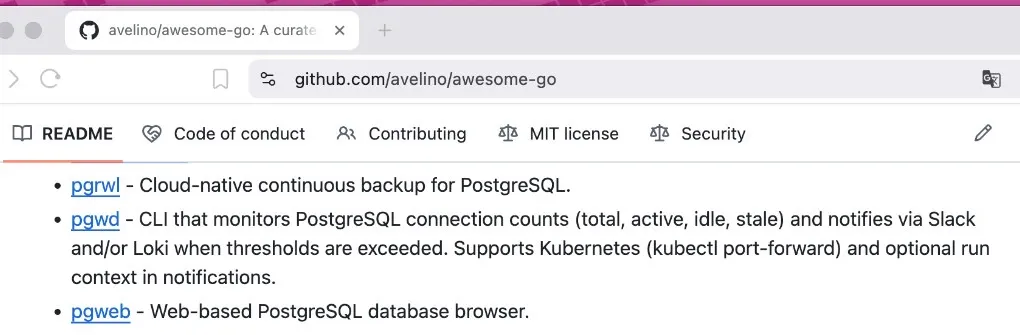
It sits in Database → Database Tools, between pgrwl and pgweb. The merged pull request is #6702 (20 September 2026). The blurb they accepted is the job, not the marketing:
pgwd — CLI that monitors PostgreSQL connection counts (total, active, idle, stale) and notifies via Slack and/or Loki when thresholds are exceeded. Supports Kubernetes (kubectl port-forward) and optional run context in notifications.
That is the product in one line. Connection counts, thresholds, Slack and/or Loki, optional Kubernetes port-forward. A small Go CLI. Config in YAML. Operator layouts live in pgwd-selfhosted.
Why this one made me smile
Three weeks ago I wrote that pgwd had landed on awesome-postgres. Awesome Go is a different map: Go people, not only Postgres people — and the destination repo sits at roughly 185k stars. Being on that list is a privilege. It is still not a trophy. It is a signpost. Someone looking for “how do I notice when Postgres is out of connections” in the Go ecosystem can now trip over pgwd the same way they trip over other Database Tools.
The first try was #6049 in February 2026. Maintainers closed it with re-submit in 5 months. We waited, kept shipping, and came back with the current template (pkg.go.dev, Codecov, SemVer). That patience was the lesson.
Thank you to the awesome-go maintainers and the automated quality checks that keep the bar honest, and to everyone who has starred, packaged, or filed an issue on pgwd. If you already run it, you did not need a list to find it. If you do not, the list is a fair place to start.
gghstats baseline (frozen)
GitHub only keeps traffic for 14 days. I run gghstats so the series does not fall off the cliff. Same evening as this note I exported the ecosystem JSONL and froze the hrodrig/pgwd slice here as a baseline, not as a victory lap.
Live dashboard: gghstats.hermesrodriguez.com/hrodrig/pgwd. The hero image above is the live Awesome Go README on 20 September 2026 — pgrwl, pgwd, pgweb in one tight frame. Below is the gghstats page for hrodrig/pgwd the same evening, locale EN (cards = dashboard totals in SQLite, not the 30-day JSON slice).
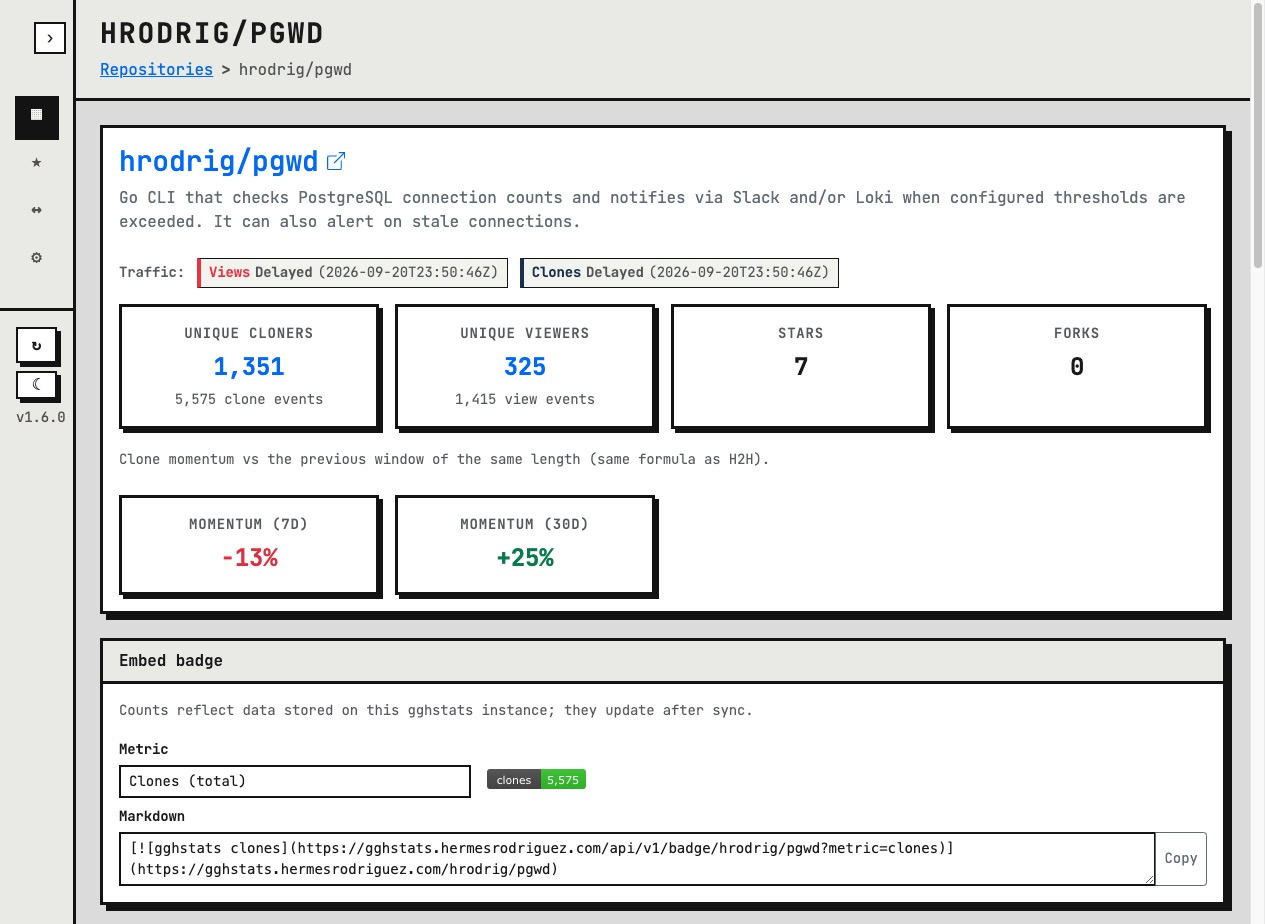
Frozen file: gghstats-hrodrig-pgwd-20260920.json (from gghstats export 2026-09-20 23:59, clones/views series through 19 September; merge-day traffic will land in later days’ buckets).
| Metric (dashboard totals @ export) | Value |
|---|---|
| Rank by clones | 1st · ~18.15% of the tracked list |
| Unique / clones | 1,351 / 5,575 |
| Unique / views | 325 / 1,415 |
| Stars | 7 |
| Momentum 7d / 30d | −13% / +25% |
| Activity 1d / 7d / 30d | 4 / 30 / 626 |
I will not pretend every future clone is “because Awesome Go.” The PR, GitHub notifications, the list itself, and whatever else people click all land in the same daily buckets. The point of freezing the file is so a later export can be compared against this evening instead of against GitHub’s 14-day amnesia — the same discipline as the awesome-postgres baseline.
Links
- List: Awesome Go → Database Tools
- PR: avelino/awesome-go#6702
- Earlier: pgwd on awesome-postgres
- Product: github.com/hrodrig/pgwd · pgwd.hermesrodriguez.com
- Install:
curl -fsSL https://get.pgwd.hermesrodriguez.com/install.sh | sh - Operator deploy: pgwd-selfhosted
- Traffic baseline: gghstats / hrodrig/pgwd · JSON snapshot 2026-09-20
If the listing helps one Go operator catch a too many clients night before the app does, that is enough joy for me.